
Reports
kLa Measurement in Shake Flask Cultures: Understanding and Optimizing Oxygen Transfer
Oct
The Hidden Variable in Shake Flask Cultures
Shake flasks are among the most commonly used vessels in microbial and cell culture research. They are inexpensive, readily available, and easy to handle — which is why they are found in virtually every bioprocess development laboratory. Despite their widespread use, one critical process variable is routinely left unmeasured: oxygen transfer.
In aerobic processes, including microbial and cell cultures, cells depend on a continuous and adequate supply of dissolved oxygen to support growth and metabolism. The rate at which oxygen moves from the gas phase into the liquid medium — the oxygen transfer rate (OTR) — is not fixed. It depends on the specific conditions of each experiment: flask geometry, shaking speed, fill volume, temperature, medium composition, and the type of closure used. Because these variables interact with one another, the actual oxygen availability in a given flask under a given set of conditions is rarely what a scientist assumes it to be.
When oxygen transfer goes unmeasured, the consequences are often attributed to other causes — variability in cell line performance, inconsistent inoculum quality, or unexplained batch-to-batch differences. In many cases, the root cause is simpler: the flask was oxygen-limited, and no one knew. Shaking speed is a common example: a speed set years ago may no longer suit a process where cell densities have since increased, and a simple kLa measurement across two or three speed setpoints can quickly identify whether an adjustment is warranted.
Why Insufficient Oxygen Transfer Creates Problems
When the oxygen uptake rate of the culture exceeds the rate at which oxygen can be transferred into the medium, the culture becomes oxygen-limited. This has well-documented consequences for culture performance:
- Reduced growth rates. Cells slow down or enter stationary phase earlier than expected, limiting achievable cell density and productivity.
- Unwanted byproduct formation. When oxygen is limiting, cells shift toward anaerobic or mixed-acid metabolism, producing byproducts such as lactate, acetate, or ethanol that can be inhibitory or detrimental to product quality.
- Irreproducible results. Small differences in fill volume, shaking speed, or ambient temperature between experiments change the effective oxygen transfer rate. If these variables are not controlled or characterized, results will vary between runs even when everything else appears identical.
- Scale-up failures. Perhaps most consequentially for bioprocess development, shake flask conditions that appear adequate at small scale may not translate predictably to stirred-tank or bioreactor environments. When the oxygen environment in the flask is not characterized, there is no reliable basis for matching those conditions at larger scale, and unexpected performance gaps during scale-up are common.
It is also worth noting that excess dissolved oxygen can be harmful — in mammalian cell cultures, sustained hyperoxia can promote oxidative stress and reduce viability.
Adjustments such as increasing shaking speed or reducing fill volume are often used in practice to improve oxygenation. Without measurement, however, these adjustments remain empirical guesses. Understanding the magnitude of the change requires knowing the actual oxygen transfer characteristics of the system.
Describing Oxygen Transfer: kLa and kW Explained
In a sealed shake flask fitted with a filter closure, oxygen reaches the culture medium through two sequential transfer steps:
- Transfer from the atmosphere through the filter closure into the headspace — governed by a mass transfer coefficient denoted kW, which is primarily a property of the filter material, its area, and temperature. For most standard filter-paper or membrane closures on flasks of 1 liter or smaller, kW typically falls in the range of 1–10 × 10⁻⁷ m³/s and is largely independent of shaking conditions.
- Transfer from the headspace into the liquid medium across the gas-liquid interface — a gas-liquid mass transfer step governed by the volumetric mass transfer coefficient kLa. The term kLa combines the liquid-side mass transfer coefficient (kL) with the gas-liquid interfacial area per unit volume (a) and is commonly used to quantify how effectively oxygen transfers into the liquid phase. Unlike kW, kLa is highly sensitive to experimental conditions and process parameters. It varies significantly with shaking speed, orbital diameter, flask geometry, fill volume, liquid properties, and temperature. This means that kLa must be determined empirically for the specific conditions used in a given laboratory rather than assumed from general reference values.
The equilibrium relationship between oxygen in the gas phase and dissolved oxygen in the liquid can be described using Henry’s law. Together, these two coefficients determine the maximum oxygen transfer rate (OTRmax) achievable under a given set of conditions. If either coefficient is limiting, oxygen availability will be constrained regardless of how favorable the other parameter appears.
kLa Measurement: The Dynamic Nitrogen Outgassing Method
Historically, dynamic methods for measuring kLa in shake flasks required custom instrumentation that was not widely accessible outside of specialized engineering laboratories. Advances in miniaturized dissolved oxygen (DO) sensor technology — both optical and electrochemical — have made kLa measurement practical for standard bioprocess development labs.
The dynamic nitrogen outgassing method is the most common approach. It is also called the dynamic gassing-out method or simply the gassing-out method. This method removes dissolved oxygen from the medium using nitrogen for a short time. Then, it monitors how the dissolved oxygen returns as it moves back toward saturation under normal shaking conditions. The rate of that rebound reflects the oxygen transfer capability of the system.
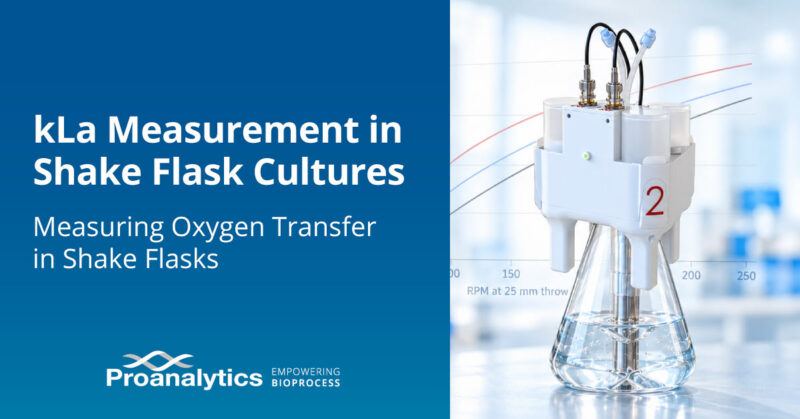
The atSpiro ShakeReactor is well suited for this measurement. It has built-in real-time DO monitoring, ports for sampling headspace and liquid, and a compact design. It attaches directly to standard Erlenmeyer flasks without changing the incubator or shaker.
How to Measure kLa Across Fill Levels and Shaking Speeds
- Set up the flask at the conditions to be characterized — fill volume, shaking speed, temperature, and closure type — and attach the ShakeReactor, including sterile, single-use, in-situ DO sensor.
- Record a 100% DO / dissolved oxygen saturation baseline while shaking under normal conditions.
- Connect a nitrogen supply to the liquid-phase sampling port and purge dissolved oxygen from the medium while shaking continues, until a stable 0% DO reading is achieved.
- Stop shaking and flush the headspace through the headspace sampling port with a volume of atmospheric air at least three times larger than the headspace volume, to restore the gas-phase oxygen concentration.
- Restart shaking and record the rebound in dissolved oxygen concentration as a function of time.
- Fit the rebound curve from 10% to 90% DO saturation to determine kLa. The measurement can be performed using a standard curve-fitting approach or its linearized equivalent via linear regression.
kLa measurement should be performed across a range of fill levels and shaking speeds to build a reliable process characterization of the system. Three measurement points per variable are generally sufficient to establish a correlation from which kLa can be interpolated for any intermediate condition.
Calculating Maximum Oxygen Transfer Rate (OTRmax)
Once kW and kLa are known, the maximum oxygen transfer rate into the culture can be estimated using the following relationship:
OTRmax is a function of both kLa and kW, the oxygen concentration gradient across each interface, and the liquid volume in the flask.
Practically, this means that for a given flask geometry and fill volume, OTRmax can be predicted as a function of shaking speed. Published data for Corning polycarbonate Erlenmeyer flasks show that OTRmax in a 1-liter baffled flask at 300 mL fill rises from approximately 10 mmol/L/h at 100 RPM to over 30 mmol/L/h at 250 RPM. These values were measured at a 25 mm orbital diameter. Baffled flasks also consistently outperform non-baffled configurations under equivalent conditions.
Figure 1. OTRmax as a function of RPM for 100 mL, 200 mL, and 300 mL fill volumes in a 1 L baffled Corning polycarbonate flask closed with a filter closure (kW = 2.67 × 10⁻⁷ m³/s).
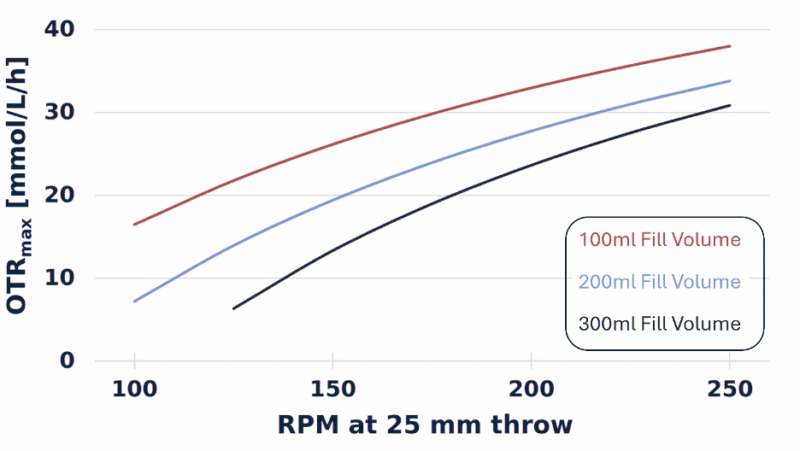
The practical design criterion is straightforward: OTRmax for the experimental conditions chosen should exceed the expected maximum oxygen uptake rate (OUR) of the organism or cell line, with a recommended safety margin of 20–30%. Published literature provides specific oxygen consumption values (qO₂) for common microbial and mammalian cells. These values are fairly consistent across clones of the same species. This means researchers can estimate oxygen use without extra experiments in most cases
Reference kLa Values for Common Flask Configurations
atSpiro has characterized kLa across a range of flask sizes, baffle configurations, fill levels, and shaking speeds using buffered saline solution as a reference medium and Corning polycarbonate Erlenmeyer flasks. Key observations from that dataset include:
- Baffled flasks deliver significantly higher kLa than non-baffled flasks at equivalent fill volumes and shaking speeds, due to increased turbulence and gas-liquid surface area renewal.
- kLa increases approximately linearly with shaking speed, with a slightly exponential relationship at higher speeds.
- Lower fill volumes produce higher kLa by increasing the headspace-to-liquid ratio and the gas-liquid interfacial area relative to the liquid volume. Alternative shake flask designs can also be used to improve gas exchange and oxygen availability. This increases the available gas-liquid exchange area relative to the culture volume, supporting more effective oxygen transfer. The recommended fill range for adequate oxygen transfer and stable fluid behavior is 15–20% of flask volume.
- 500 mL and 1000 mL baffled flasks show broadly comparable kLa profiles at matched fill volumes and speeds, with the 500 mL configuration generally achieving somewhat higher kLa at equivalent conditions.
Figure 2 — kLa as a function of RPM across three flask configurations
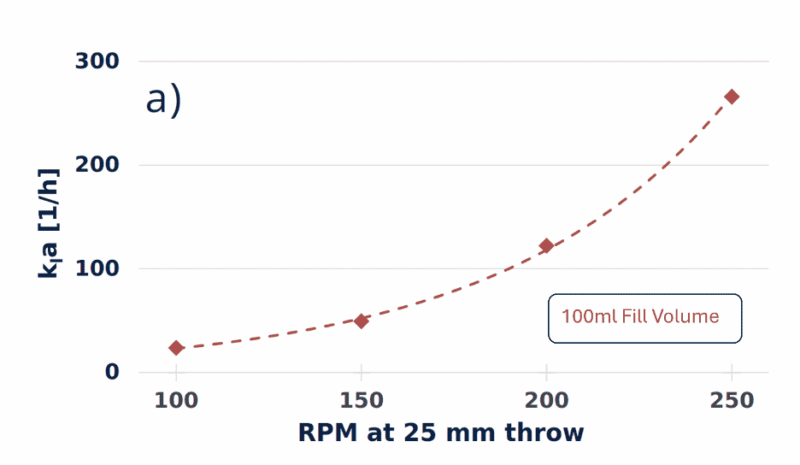
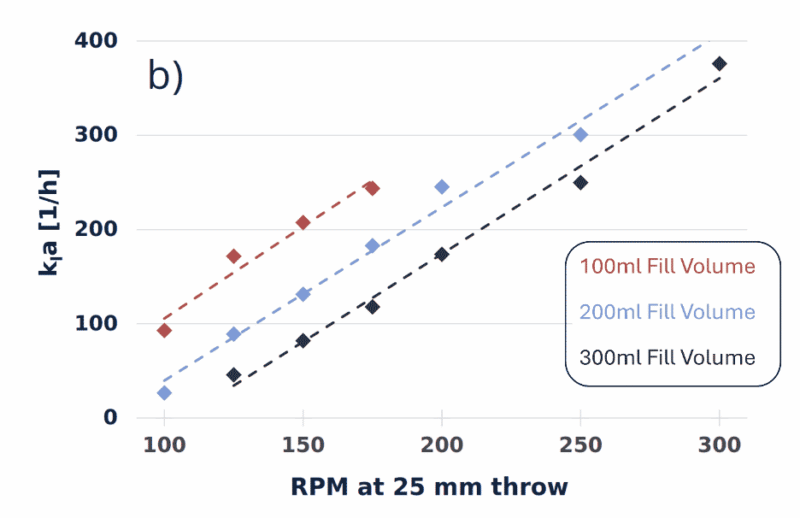
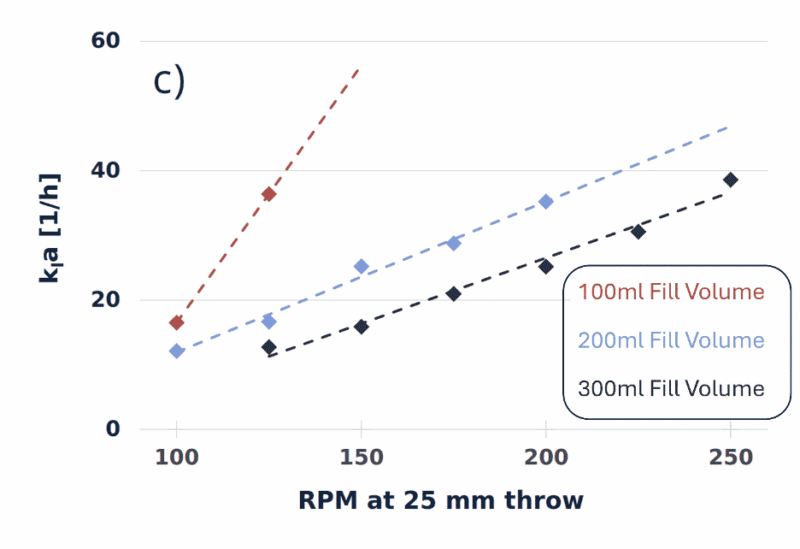
These reference values allow researchers to estimate oxygen transfer for common experimental conditions, even without performing a dedicated kLa measurement, though direct measurement remains more accurate for specific medium formulations or non-standard conditions.
Practical Recommendations for Improving Oxygenation
Based on the characterization data and the underlying oxygen transfer principles, the following recommendations apply to most shake flask cultivation scenarios:
Use a fill volume of 15–20%.
This range provides sufficient gas-liquid interfacial area relative to liquid volume to support meaningful oxygen transfer while keeping the liquid in phase with the orbital shaking motion. At fill volumes much below 15%, fluid behavior can become erratic.
Select appropriate filter closures.
Cotton plugs, aluminum foil caps, and solid closures restrict gas exchange at the flask mouth and can create headspace oxygen depletion during active cultures. Membrane-based or thin filter-paper closures with adequate kW are strongly preferred. The ShakeReactor and Corning polycarbonate flasks with vented cap have a kW of approximately 2.5 × 10⁻⁷ m³/s, which is suitable for most cultivation conditions.
Use baffled flasks for high-density cultures.
Baffles increase turbulence and surface renewal at the gas-liquid interface. They are particularly beneficial for high-density microbial cultures and can also be advantageous for mammalian cell applications where oxygen demand is elevated.
Minimize foam formation.
Excessive foaming creates a layer that insulates the culture from the headspace, reducing effective oxygen transfer and introducing run-to-run variability. Small quantities of antifoam agents can address this without meaningful impact on culture performance in most applications.
Revisit shaking speed as process conditions change.
A shaking speed established early in process development may not remain optimal as cell densities, media, or clones are improved. A brief kLa measurement across two or three speed setpoints can confirm whether the current speed is still appropriate or identify a better operating point — often with meaningful gains in reproducibility or productivity.
Use published reference kLa tables when direct measurement is not available.
Labs without dissolved oxygen monitors can use published reference values. These values cover common flask and closure setups. They help estimate oxygen transfer and find possible problems before starting culture experiments.
Monitor dissolved oxygen in real time when possible.
Real-time DO measurement gives direct and continuous information about oxygen in the culture. It helps quickly spot when oxygen is limited. This supports improving the process based on data. This represents the most reliable approach to ensuring consistent oxygenation across experiments.
The ShakeReactor: Turning Flasks into Bioreactors
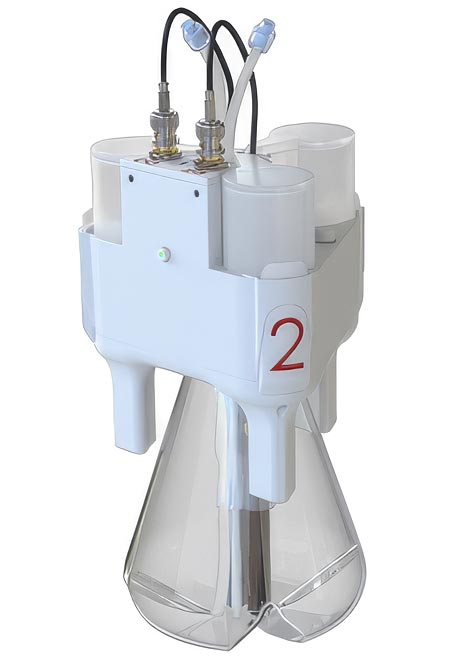
The ShakeReactor, developed by atSpiro (Copenhagen, Denmark), is a wireless, battery-powered add-on device that attaches to 500 mL and 1000 mL Erlenmeyer flasks. It is designed to take up no more space than the flask itself and can be set up in approximately 10 minutes, requiring no modification to existing incubators or orbital shakers.
The device integrates three independently programmable micro-pumps for:
- Feeding
- Induction agent addition
- pH control
It also provides online measurements of dissolved oxygen, pH, ambient temperature, and humidity for real-time monitoring and post-run analysis. Two Luer-lock sampling ports allow connection of a nitrogen supply and air source for kLa measurement using the dynamic outgassing method described above.
The ShakeReactor combines online DO and pH monitoring with programmable liquid addition. This lets researchers use the same basic bioprocess control methods as in stirred-tank bioreactors. These methods include fed-batch feeding, pH control, and oxygen measurement. The ShakeReactor works in a standard shake flask that fits any normal incubator. This improves the relevance and transferability of shake flask data to larger-scale systems.
ProAnalytics serves as the authorized US representative for atSpiro. For product information, demonstrations, and application support, contact ProAnalytics at info@pro-analytics.net or visit pro-analytics.net.
Understanding Oxygen Transfer and kLa Importance in Shake Flask Cultivation
Oxygen transfer is a fundamental variable in shake flask cultivation that is routinely left uncharacterized, even though its effects on culture performance — reduced growth, metabolic shifts, irreproducibility, and scale-up failures — are well established. The volumetric mass transfer coefficient kLa and the filter closure coefficient kW help understand and predict oxygen availability. They provide a quantitative basis for this under specific experimental conditions.
kLa measurement using the dynamic nitrogen outgassing method is now straightforward with commercially available dissolved oxygen monitoring systems. Once kLa is known, maximum oxygen transfer rates can be calculated, experimental conditions can be designed with confidence, and results become more reproducible and more predictably transferable to larger-scale systems.
The ShakeReactor from atSpiro offers an easy way to monitor dissolved oxygen in real time. It also helps measure kLa and control bioprocesses actively in standard Erlenmeyer flasks. This tool improves shake flask experiments and produces better data for later process development.
Frequently Asked Questions About kLa Measurement
kLa is the volumetric mass transfer coefficient. It combines the liquid-side mass transfer coefficient, kL, with the gas-liquid interfacial area per unit volume, a. In shake flask cultures, kLa is used to describe how effectively oxygen transfers from the gas phase into the liquid medium.
kLa helps quantify the oxygen transfer capability of a shake flask under specific operating conditions. Because kLa changes with factors such as shaking speed, orbital diameter, flask geometry, fill volume, liquid properties, and temperature, measuring it can help identify oxygen limitations and improve reproducibility.
One established approach is the dynamic nitrogen outgassing, or dynamic gassing-out, method. Dissolved oxygen is first stripped from the liquid with nitrogen. After the headspace is restored with atmospheric air, shaking resumes and the dissolved oxygen rebound is measured over time. The rebound curve can then be used to determine kLa.
Lower fill volumes generally produce higher kLa because they increase the gas-liquid interfacial area relative to the liquid volume. For the flask configurations discussed in this application note, a fill volume of approximately 15–20% is recommended to balance oxygen transfer with stable fluid behavior.
kLa is one of the parameters used to determine how much oxygen can be transferred into a culture. Together with the filter closure coefficient kW, the oxygen concentration gradient, and the liquid volume, kLa helps determine the maximum oxygen transfer rate, or OTRmax, under a given set of experimental conditions.
In a shake flask bioreactor, kLa can be measured using a dynamic gassing-out method. Dissolved oxygen is first stripped from the liquid with nitrogen while the flask is shaking. The headspace is then restored with atmospheric air, shaking is resumed, and the increase in dissolved oxygen concentration is recorded over time. The resulting oxygen rebound curve is used to calculate kLa under the specific operating conditions being tested, including shaking speed, fill volume, temperature, and flask configuration. Systems such as the atSpiro ShakeReactor simplify this process by providing integrated dissolved oxygen monitoring and sampling ports for gas connections.
ProAnalytics, LLC is the authorized US representative for atSpiro. Technical content in this application note is drawn from atSpiro’s published white paper “Oxygen Transfer in Shake Flask Cultures” and is presented for educational purposes. For product inquiries, contact ProAnalytics at info@pro-analytics.net or (973) 241-1314.
