
Reports
Metabolite analysis in cell culture – Photometric analyzer vs membrane-based systems

Oct
Optimization of Glutamine Measurement in Cell Culture Operations
Current “membrane-based” instrumentation utilized at a large cell culture manufacturing site has presented recurrent problems, including non-repeatable, inaccurate metabolite analysis, especially of Glutamine. These membrane / electrochemical technologies have shown inherent flaws in measurement stability and excessive maintenance at multiple sites. Newer optical-based metabolite analyzers were evaluated to determine whether superior measurement results with less frequency of calibrations could be obtained. The goal of this study was to evaluate Photometric Technology and compare its performance versus current units in use.
The evaluation of metabolite analysis equipment was conducted using 4BioCell assays in models BioCore and BioCompact Photometric Analyzer. ProAnalytics, LLC of Fairfield, NJ (technical representative/distributor for 4BioCell), coordinated the evaluation, working with Upstream Process Development scientists at a large biopharma organization.

Technology Overview
The optical / photometric analyzer is at its most basic form, a very accurate pipetting system and also a colorimetric detector.
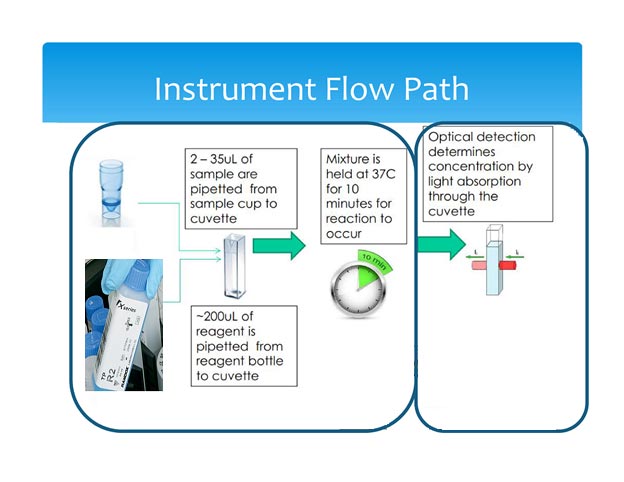
The photometric analyzers pipette 2-35uL of sample into a single-use or reusable cuvette. Subsequently, the instrument pipettes 100-200uL of reagent for a specific metabolite into the same cuvette. The cuvette is then mixed, and an enzymatic reaction occurs, which creates a color. The color concentration is read by an optical detection system. The color concentration is correlated with a known metabolite concentration.
Pipetting accuracy and repeatability is critical for the photometric technology. The 4BioCell instruments provide pipetting tests based on color dilutions, which can prove the accuracy and repeatability for GMP areas.
In addition to special color testing reagents for metabolite analysis, 4BioCell offers Standards / Controls, which are a material containing a known concentration of each metabolite. Many cGMP facilities load one Control sample along with their Normal sample types for every run. This additional data analysis proves to the FDA that the instrument has performed the process run properly by detecting an accurate concentration level of the metabolite within tolerances of the expected Control value.
The software has been tested by the scientists and is found to be intuitive, user-friendly and focused towards biotech applications. Simple sample loading will help eliminate any errors within the manufacturing facility.
User Interface


4BioCell has a full list of metabolite / analyte reagents available. Some of the common biotech reagents are as follows:
| Acetic Acid | Ammonia | Calcium | Chloride | Cholesterol |
| Copper | Ethanol | Glucose | Glutamate | Glutamine |
| Glycerol | hc IgG | hc Protein | hs IgG | hs Protein |
| Phosphate | Iron | Lactate | LDH | Magnesium |
| Potassium | Sodium | Triglycerides |
The 4BioCell metabolite analyzers have one pipettor, which is self-cleaned. The BioCore is capable of holding up to 10 samples and up to 20 reagent bottles, while the BioCompact can hold up to 46 samples and 16 reagent bottles. Very low sample volume is required for these instruments (300-350ul). The cooled reagent compartment is critical for reagent stability and extending lifespan.
BioCore Instrument Overview

BioCompact Instrument Overview

Maintenance is very simple for the 4BioCore Biochemistry Analyzers. On a daily schedule, an operator will check that there are enough disposable cuvettes loaded onto the instrument (for the BioCore instrument) and that there are enough reagents remaining. The pipette will be wiped with alcohol on a daily basis. The user will calibrate the analytes monthly. The instrument will automatically prime DI water through the system if not operated for a certain length of time. No special storage conditions need to be maintained for the instrument while it is not operating.
Once per month, the liquid lines will be flushed for 15 minutes with a cleaning solution automatically, followed by flushing with DI water for 15 minutes.
Twice per year, the syringe pumps will be calibrated for accuracy, along with further cleaning of air and liquid filters.
The halogen lamp will be changed when the instrument alerts that the bulb has been used for 1,000 hours.
Calibrations are performed very infrequently – as little as every 2 or 4 weeks.
Comparison of photometric and electro-chemical/membrane based platforms:
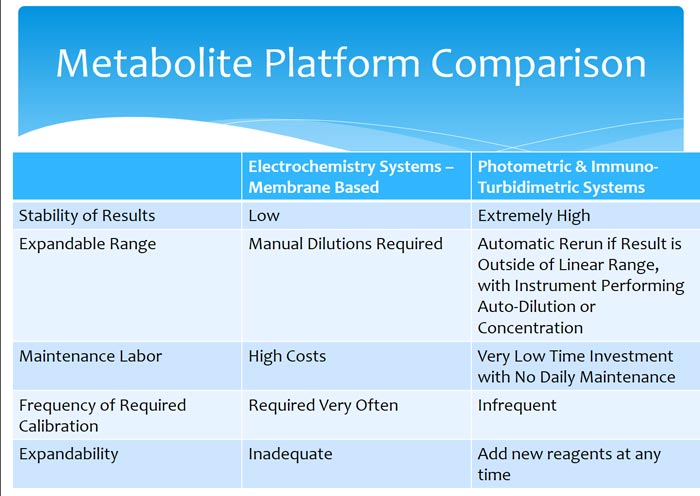
Streamlined Metabolite Analysis with Flexible Automation and Data Integration
Expandability for additional metabolites and reagents is quite flexible for these instruments, providing the user with the capability to pick and choose the exact reagents that are required for any specific tests or samples within the lab or production environment. Automation is possible through the use of autosampling. Data can be streamed in real-time through universal communication protocols to a facility data historian. Sample volumes required for these biochemistry analyzers are quite low.
The instrument is already used within cGMP areas. Multiple levels of login credentials can be set, which the FDA recommends in order to meet 21CFR11 compliance.
Conclusion
It is our recommendation to change the technology of the metabolite analyzer within the manufacturing area from the older membrane-based systems to the newer photometric analyzers from 4BioCore:
- A significant amount of cost can be saved by the much lower labor required to maintain the instrument.
- Improved VCD and Titer can be achieved within Manufacturing by improved accuracy of metabolite analysis.
- Additional metabolites of interest (re: IgG, total protein, LDH) can be measured using the 4BioCore, which were not available for the membrane-based system.
- Flexibility in metabolite detection limits can be used, preventing the need for human error introduced by manual dilutions.
- Photometric calibrations are performed very infrequently – only every 4 weeks. Being performed infrequently and on a scheduled basis means that the workflow is not interrupted like it is for the current setup.
Appendix
I: BioCore and BioCompact Specifications
| BioCore | BioCompact | |
|---|---|---|
| Number of Samples | 10 | 46 |
| Tests Per Hour (Throughput) | 150 | 200 |
| Sample Volume | 300ul | 300ul |
| Instrument Dimensions (WxDxH) | 38x60x40cm | 62x60x49cm |
| Number of Reagent Bottles | 20 | 16 |
| Cuvettes | Single-Use | Reusable |
